« September 2011 | Main | November 2011 »
October 31, 2011
Europe: an effective economic strategy?
Jeff Madrick in How to Save Europe in the New Review of Books blog says that Europe has enough money to bail out Greece, provide support for Italy, Spain and Portugal, and keep its banks whole.
If the Europeans come together to solve their sovereign debt crisis it will mark the success of one of the great political and social experiments of our time; it will be tragic for Europe and for the world if they do not. So we have a political crisis of the eurozone – one that calls into question the very existence of the European project as a whole.
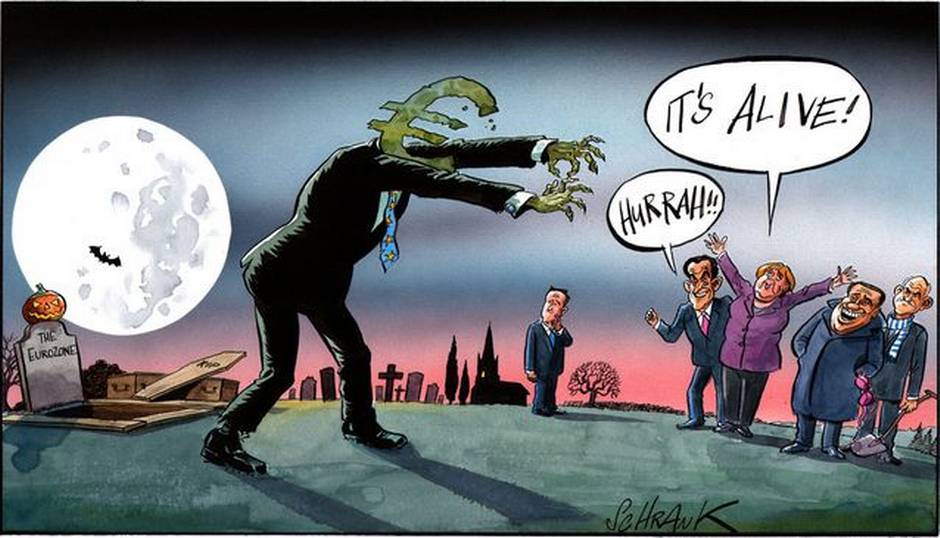
As we know the sovereign debt crisis in Europe is the result of the global financial crisis. But how did this come about? I've assumed that that the banks all ate too much US subprime debt and they got really sick, whilst the nation state's ballooning debt was the result of easy and cheap credit.
This overlooks that the eurozone banks may be a problem in themselves because they have huge balance sheets with a lot of low-return investments and that investors have little confidence in them. The austerity programs being put in place, and which will put Europe on a deflationary path, will not help the banks. Fixing the financial sector is necessary for economic recovery, but far from sufficient.
As growth prospects continue to weaken the Eurozone governments will come to recognize that government plays a central role in financing the services that people want, like education and health care; and that government-financed education and training, in particular, will be critical in restoring competitiveness in Europe.
Meanwhile fiscal austerity rules mixed with a "plan" to restore confidence--hardly an effective economic strategy. It hasn't worked so far, especially in Greece. Until eurozone governments start bailing out the real economy, rather than the banks, with public investment for growth, the rescue packages will go on failing.
Update
George Papandreou, the Greek Prime Minister, has announced a plan for a referendum on the austerity measures imposed by his European partners in January. This was not part of the Euro rescue script. Is the goal of Papandreou’s move to renegotiate the terms of the deal imposed on Greece? Papandreou has also called a vote of confidence in his government for Friday night. Greece now faces a two-month period of being in limbo and economic uncertainty.
Papandreou's reason for a referendum was that the referendum remained the only way of overcoming public opposition to the spending cuts agreed as part of the eurozone rescue package. The spending cuts mean job losses, pay and pension cuts, the loss of public services and hope. Papandreou's manoeuvre is, of course, a last-ditch attempt to save his political skin after months of mass street action over previous helpings of failed austerity that have driven Greek society to the brink.
So the Greek people are to decide their own fate. That begins to address the democratic deficit in Europe. The European political class are aghast.
Up to now the Greek people say that they want to stay in the eurozone, but they don't want to pay off their debts. Polls in Greece have shown that 60% of the population are against the terms of the bailout but 70% are against leaving monetary union There is a real possibility that a no vote could plunge Greece into bankruptcy, force it out of the eurozone and a return to the drachma.
Europe does not have a Plan B in the event of a Greek default. Even if the Greeks vote yes and the wider eurozone buckles down to the German version of austerity and economic discipline with a neo-liberal mode of governance structured around deregulation, privatisation and the privileging of corporate power, it is not clear how long the gimmick Plan A can hold. China is meant to plug the financing gaps.
Posted by Gary Sauer-Thompson at 7:05 PM | Comments (6) | TrackBack
October 30, 2011
Qantas: lockout
Qantas has upped the ante in its industrial dispute with the unions with its decision to ground all its aircraft --both national and international. It has escalated the conflict rather than pursue the negotiating option. The indications are that the battle plan for a lockout has been planned for some time by the Qantas Board, and the dramatic escalation of its industrial dispute indicates Qantas' determination to play hardball in order to be break the power of the unions.
The Gillard government was forced to apply to Fair Work Australia to end the dispute because Qantas grounding its fleet forced the government's involvement. So a federal industrial tribunal has been utilized to resolve a major industrial dispute. Will it resolve the unions opposition to Qantas' determination to outsource and offshore some of its functions? Qantas claims that this is properly the domain of company management, not the unions.
The Fair Work Act provides a mechanism for resolution of the dispute through the industrial umpire, Fair Work Australia. Section 431 of the Fair Work Act allows the Minister to terminate industrial action immediately where it can be demonstrated the strike action will cause damage to an important part of the economy or is endangering the community (for example, a dispute affecting hospitals or emergency services). The Minister needs to be satisfied (ie. does not need to be justified legally) that the activity is causing serious damage to an important part of the economy.
The parties have 21 days to sort things out between them. If no agreement is reached, Fair Work Australia could then arbitrate an outcome of the dispute (or it could do so after a further 21-day conciliation period, if all parties agreed to that). Essentially, this would enable Fair Work Australia to broker an agreement determining employment conditions for the relevant Qantas staff for the next few years.
Update
Ten years ago Qantas was widely hailed as one of the strongest airlines in the world. Qantas is now potentially squeezed between Virgin’s aggressive campaign for the premium domestic traveller and lower cost Asian competitors. Qantas International has an ageing, fuel-inefficient aircraft fleet that is compounded by delays in the delivery of new planes. It is running at a loss despite its protection.
Its strategic response has been to follow through the logic of the Jetstar model (cheaper labour) on a global scale even at the longer term expense of the Qantas brand. Its proposed regional hub model based in Asia depends in it regaining international competitiveness.
Qantas' rhetoric is to blame the unions for their unconstructive attitude to the reduced pay and working conditions, and their desire to have a say in how the company strategically responds to its situation of decline and its future as an international airline. In Crunch time for Qantas Stephen Bartholomeusz says:
the issues at the heart of the confrontation weren't conventional industrial relations issues. They were fundamentally about who controls the management and the strategy of the company as it seeks to stake out a viable future in an increasingly difficult international industry environment....Joyce and Clifford see Qantas' international future, in part, depending on creating a hub-style carrier out of Asia, with a combination of the Jetstar brand and a new premium carrier with work practices and cost structures that would enable the group to compete with the Asian and Middle Eastern carriers that have decimated its market share of routes into and out of Australia.The unions want to hang onto the privileged position they have inherited.
If the negotiations required by Fair Work Australia fail after 21 days, then a binding arbitration by Fair Work Australia will take place. It is this compulsory arbitration that the Liberal Party is opposed to.
Posted by Gary Sauer-Thompson at 10:23 PM | Comments (21) | TrackBack
October 29, 2011
Occupy London
The Church of England appears to be split about whether the Christian thing is to embrace the protesters encamped on the doorstep of its cathedral.
Should it join forces with the fat cats who run the City of London and have the protest camp evicted? Or allow the Occupy London protestors to stay encamped on the piazza outside St Paul's?

Despite St Paul’s decision to pursue eviction proceedings, the protesters are keeping discussion about the need for banking reform in the public spotlight. The realization of the Occupy London movement is that the ongoing crisis represents a problem with capitalism per se, and not just the regulation of the finance industry. Capitalism is now clearly re-emerging as the name of the problem because they feel the system has let them down and it is isn’t fair. The extreme inequality means that we have system failure.
An editorial in The Observer states:
It's fashionable to say that the protesters' demands are too broad and vague. Yet, what they are achieving is to reclaim a public realm for debate and engagement, one that the privileges given to finance have done so much to destroy. If nothing else, practising a different kind of politics and calling for finance to be made subservient to useful social, economic and environmental purposes, to make things better rather than worse, is enough for one demonstration
In contrast to the system failure position of the Occupy London movement the chairman of the London Stock Exchange has said that they are blaming the wrong people. They should target the politicians who allowed banks to run up huge debts:
There are unintended consequences of free markets. It's not capitalism that has been the problem, but irresponsible governments and politicians who have allowed the financial system to explode by permitting the build-up of ludicrous amounts of debt and leverage. No one ever said that free markets could oliticians have lost control of the system according to this spokesperson for global finance,or would be self-regulating.
Politicians have lost control of the system according to this spokesperson for global finance,
It is an assumption of economic theory (and Alan Greenspan) that markets are like a natural system that will self-correct provided they are left alone--eg., Adam Smiths invisible hand. However, markets are created systems, and they are not self organising systems that incline towards balance. They become out of control exercises in chaos that move towards anything but equilibrium.
The chairman of the London Stock Exchange says nothing about how City interests have compromised and captured some of the most powerful institutions in the UK. The City and Wall Street have ruled unchallenged for several decades and they act to ensure that there shall be no serious challenge to the power of finance capital to rule the UK and the US from the state apparatus.
Posted by Gary Sauer-Thompson at 9:44 PM | Comments (2) | TrackBack
October 28, 2011
toxic media brands
It's a simple proposition that makes a lot of sense.
Newspapers role in a digital world is to focus on making sense of the news rather than breaking it. Traditional journalism for print media doesn’t earn its keep any more and there’s no future in telling people what they’ve already learned from their mobile phone. Simple.
Making sense of the news--ie., interpretation---makes a break from what the media traditionally understand as good journalism---they generally mean Four Corner's style investigative journalism. Newspapers won't have the resources to do that.
As we have become aware interpretation of the news can quickly become s partisan polemic and mass deception of tabloid journalism. A recent example from Channel Seven's Today Tonight:
Here is the critical response from the ABC's Media Watch. I interpret it as an argument for strong regulation of the media to make it more accountable to citizens.
The political undercurrent behind the tabloid polemics and deceptions is the obvious link to them between enforced egalitarianism and tyranny--- it is that the Welfare State's attempts to promote equality that have left the poor much worse off. So it is necessary to reverse that trend to equality because the very idea of a “share of wealth” (eg., the mining tax) should, and must, be recognised as a deeply sinister one. The politics is rewarmed up 19th century liberalism.
This kind of media politics is "the way things are done." It is the new normal. Routine. Journalists implement the politics ---as in the opposition to gambling reform. This kind of normalization, with its language of us and them to make the deceptions palatable, comes easily when money, status, power, and jobs are at stake. The journalists operate unthinkingly, following orders, efficiently carrying them out, with no consideration of their effects upon those they've targeted.
Posted by Gary Sauer-Thompson at 3:08 PM | Comments (7) | TrackBack
October 27, 2011
sweeping problem gambling under the carpet
Now why am I not surprised that James Packer wants business-as-usual at Crown Casino. He is opposed to players having to set limits on their losses before they started gambling on high-intensity machines that take large bets.
Packer's reason? This reform wouldn't reduce problem gambling and it will cost jobs and investment across the industry and cost the state government tax revenue used for essential community services. So what is to be done about problem gambling and addiction? Packer doesn't say. The problem gamblers are the means for making profits.

What Packer explicitly denied is that it is problem gambling, not reform, that is wreaking havoc on Australian communities. Abbott steps into fill Packer's breach with his "more counselling", even though the Productivity Commission found that only 15 per cent of problem gamblers seek help.
Posted by Gary Sauer-Thompson at 7:25 PM | Comments (3) | TrackBack
October 26, 2011
Europe: economic tragedy?
Europe is facing a banking crisis as well as a sovereign debt crisis. This has been developing for two years. The euro is a shared currency outside a fiscal union – and as a currency shared by fiscally independent member-states it has generated vicious negative feed-back loops between sovereigns and banks.
The legacy of the global financial crisis in 2008 was a sovereign debt crisis in parts of the eurozone, and a banking crisis across the region as a whole. The two crises have fed on each other ever since, with weak sovereigns undermining confidence in banks and vice versa. The greatest threat to the eurozone is that this vicious feedback loop spins out of control.

Three crises have intermingled and reinforced each other: Greece, Ireland, Italy, Portugal and Spain face crises of excessive debt (public and private); those same countries suffer from low economic growth; and much of the European Union is afflicted with a banking crisis.
Much of the debt owed by Greece, Portugal and perhaps others will have to be written off, and that in turn will require a massive recapitalization of European banks (by €200-300 billion, IMF figures suggest). Then the markets will have to be calmed with a big bazooka aimed on them. Behind Europe's sovereign debt crisis sits Europe's declining economic growth. Without growth, the debt crisis will continue to re-emerge.
Governments will need to recapitalise their European banks (around €100 billion is minimally required); the banks will need to take a haircut (40-50%) on their bad debts in Greece; the firepower of the eurozone bailout fund (European Financial Stability Facility [EFSF]) will need to be increased (to €2tn?); the European Central Bank will need to become a lender of last resort to stabilize the various economies; and Italy and Greece will need to live up to their promises to get their debt and budgets in order.
Italy is the key. It has the third largest debt market in the world, well over €1trn of outstanding debt. Investors, fearing a possible default, are demanding high interest rates on Italian debt. And these high interest rates, by raising the burden of debt service, make default more likely. They'll do just enough to buy themselves more time. Italy is unwilling to engage in reform, preferring the no growth option.
So far it doesn't look as if the European political class is getting on top of the problem. Paul Krugman says
It’s a vicious circle, with fears of default threatening to become a self-fulfilling prophecy. To save the euro, this threat must be contained. But how? The answer has to involve creating a fund that can, if necessary, lend Italy (and Spain, which is also under threat) enough money that it doesn’t need to borrow at those high rates. Such a fund probably wouldn’t have to be used, since its mere existence should put an end to the cycle of fear.
Krugman adds that the problem is that:
All the various proposals for creating such a fund ultimately require backing from major European governments, whose promises to investors must be credible for the plan to work. Yet Italy is one of those major governments; it can’t achieve a rescue by lending money to itself. And France, the euro area’s second-biggest economy, has been looking shaky lately, raising fears that creation of a large rescue fund, by in effect adding to French debt, could simply have the effect of adding France to the list of crisis countries.
Yet, if the European Central Bank were to stand behind European debts, the crisis would ease dramatically. Much of the debt owed by Greece, Portugal and perhaps others will have to be written off, and that in turn will require a massive recapitalization of European banks (by €200-300 billion, IMF figures suggest).
Euroskeptical Britain — it is currently in the EU but not the euro-- is talking about its national interest and protecting the special position of the City of London and its get-rich-quick culture. Many Europhobic Conservatives-- have signed a parliamentary motion calling for a referendum on whether Britain should leave the EU or renegotiate the terms of its membership. These Eurosceptics----Little Englanders-- want splendid isolation and a neo-liberal economy.
Update
The measures are:
(1) the banks would take a 50 per cent haircut on their holdings of Greek sovereign debt. This will wipe about €100 billion off Greece’s near-€350 billion of sovereign debt. In addition there is €100bn of new loans.
(2) the European Banking Authority announced that the EU banks would raise €106 billion of new capital between now and June next year to cover the holes in their balance sheets created by the losses they face.
(3) an increase in the size of the European Financial Stability Facility, which has been trying to put a floor under the bonds issued by the more parlous economies, from €440 billion to one €1 trillion. That’s an attempt to head off any assault by the markets on the next most vulnerable economy, Italy.
What was excluded was the European Central Bank promising to purchase bonds without any arbitrary limit from every solvent but distressed sovereign state. So we fall back to the European Financial Stability Facility with its non existent €1 trillion. This is supposed to be raised by luring in private investors and the likes of Beijing through special vehicles and sophisticated insurance deals, a state-sponsored variety of the antics which occupied the markets before the crash.
The measures will not stimulate economic growth, which is what is needed to help the angry, unemployed citizens. If Europe cannot grow an economy big enough to shoulder its debts, then the crisis will not go away. For instance, Greece is bust, and the harsh austerity plans means that it will have a sickly economy, still mired in debt in nine years' time. That means more social and political unrest to follow in the months and years to come, particularly as the economic recovery will be a long time coming.
Posted by Gary Sauer-Thompson at 1:53 PM | Comments (13) | TrackBack
October 25, 2011
seductions everywhere
One of the most notable aspects of the urban environment in Melbourne is the extensive space in the public sphere that has been given over to corporate advertising. It's everywhere--on air, in print, on the street etc ---and its geared to trigger emotional responses from us, not rational ones.
 Gary Sauer-Thompson, Prada, Crown Casino, Melbourne, 2011
In an economy thriving on images the advertisers aim to minimize the space for us to interpret and analyze what we see all around us. For instance the food industry doesn't want us to consume less to reduce our waistlines; whilst the diet industry doesn't want us to know that long term, no diet has proved effective. After the initial weight loss, most people on any diet regain most of what they lost.
Posted by Gary Sauer-Thompson at 12:13 PM | Comments (2) | TrackBack
October 20, 2011
in Melbourne on a photo shoot
I'm off to Melbourne for four days on a phototrip. As I won't be taking my computer with me so I will not be blogging. The emphasis, when I'm not with Suzanne, will primarily be on photography -- the large format style and it will concentrate on this kind of urban work. There will also be a lot of digital snap shots taken.
I'll be back on deck on Tuesday after The Australian has gone behind a paywall in an attempt to ensure that readers became more used to paying for what they could previously access online free, and to extra revenue flows.
Update
There does not seem to be much commentary on The Australian's paywall experiment and how it will impact on both political journalism and the media given that the transition from print to digital, the 24 hour news cycle, and the media (feral beast) constantly moving on to the ever new instant. Will the culture of contempt practiced by News Ltd be limited to its tabloids?
We do have Laurie Oaks' Andrew Olle Media Lecture 2011, which is a defense of journalism. He says that the trust issue worries him because journalism is so central to the operation of our democracy:
We like to think of ourselves as watchdogs, keeping the bastards honest .... And that IS part of our role. But, probably more important, in my view, we in journalism are the intermediaries in the conversation between voters and politicians that makes the whole thing work. If people lose trust in what we do, how can they maintain faith in the process?...There's been a lot of criticism of political journalism recently .... Much of the criticism is directly related to this democratic dialogue between punters and pollies that we as members of the Fourth Estate are supposed to facilitate. Trust is just one aspect. What the criticism boils down to is that the changing character of the media is distorting the conversation with damaging consequences for the way our political system works. Or doesn't work.
He interprets the changing character of the media as a "dumbing down" into a sideshow:
The argument is that, with media organisations under siege from commercial pressures and technological innovation, the balance in political reporting has shifted away from providing information and towards entertainment. And that this, and the way politicians have responded, is trivialising politics and dumbing down debate.
Oaks reckons the core criticism--it's the media's fault--- is overstated, and he argues against the criticism. The fact that politicians make policy decisions on the basis of what will get the most favourable media coverage rather than what's best for the nation is due to weak politicians not the media. He adds that if you want to see a real dumbing down of politics, treat yourself to another look at recent election campaign commercials from both sides.
Oaks says that the contempt for politicians constantly on show in the media is a factor in eroding faith in the political system. That contempt arises from political parties and governments using massive resources into trying to control what journalists do and say.
Update 2
Tim Dunlop has addressed the issue of the Australian's paywall at The Drum and he goes to the heart of the matter ---that News Ltd reckons that people will pay for great journalism. Dunlop says:
News Ltd are obviously banking on the idea that The Australian produces enough quality journalism to generate enough subscriptions for the site to make a profit....How realistic is this? Not very, in my view, and at least part of the answer has to do with partisanship .... The Australian is ground zero for hardline, anti-Labor, so-called "campaigning" journalism, a position that has solidified since federal Labor came to power in 2007. This editorial disposition has made them a laughing stock amongst at least half the market for serious journalism they are going to need to make the paywall pay.
Unlike Fox News in the US The Australian cannot afford to pursue a partisan audience in Australia because that niche is not large enough to be profitable.
Posted by Gary Sauer-Thompson at 6:01 PM | Comments (3) | TrackBack
October 19, 2011
Crabb on the media
Annabel Crabb has an edited copy of a speech on changes in the media she gave at the Sydney Institute on The Drum. It is about a deep, elemental, structural revolution taking place in the media and what this means for democracy.
It is about the political class--the intertwining of politicians and journalists in liberal democracy that is most marked in the Canberra Press Gallery. The speech is more focused on the politicians than the journalists, as it pretty much ignores the bad practices of insider journalism.

Crabb acknowledges that the 20th century model of the media/politics relationship was a politico-media complex, a closed shop of ideas with its passive mass audience. She says that the status quo of the politico-media complex which has comfortably characterised political debate in Australia has changed radically in the last 10 years. In the last five, even. The old gatekeepers are losing control whose job it used to be to decide what people would or should like, are are losing control and are increasingly redundant.
Secondly, digital technology means that mass audiences are fragmenting into smaller segmented marketplace; more targeted advertising based on the information gleaned about consumer's preferences and behaviour; an active audience who critique what journalists write; and some kind of paywall---eg., Crikey now and The Australian coming very soon.
This is pretty much a summary of what we know. What then, are the implications for our deliberative democracy? For Crabb it is the disappearing town square:
The most legitimate concern about today's fractured media marketplace is that we no longer have a town square. A place where we're all on the same page. A moment - outside grand finals, or landmark episodes of Masterchef - at which a large chunk of Australians are all thinking about the same thing. ...At times, I think politicians get spooked by this freewheeling Babel of media with which they tangle each day. They are worried about getting a run in the media, to the extent that getting a run becomes the aim in itself ... they still crave control of the message, some sense that they are prevailing against the [feral] beast.
What does this mean for journalists? The dumbing down, or the coarsening of political debate, says Crabb is really democracy in action. The political discourse isn't getting stupider because we citizens have more to read.
Crabb makes no mention of the partisan campaigning style of News Ltd based on the deliberate mass deceptions and disinformation around issues, such as climate change, The Greens, and the national broadband network. She also evades the issue of journalists selling out their professional ethos to become political players with the shrill and hectoring tone of the schoolyard bully. Political journalism--both the horse race and 'she said he said' styles -- in Australia is broken backed. They more often than not write crap.
Posted by Gary Sauer-Thompson at 11:54 AM | Comments (13) | TrackBack
October 18, 2011
The US: the undeserving poor
Over the last decade, the richest 1 percent of Americans reaped vast economic benefits while the remaining 99 percent made do with stagnant incomes, rising costs, and an otherwise sluggish economy. The Great Recession -- which was caused, in part, by the reckless malfeasance of the wealthy -- accelerated and exacerbated these trends, but they were long in the making.
In his New York Times column Paul Krugman says that:
Wall Street’s Masters of the Universe realize, deep down, how morally indefensible their position is. They’re not John Galt; they’re not even Steve Jobs. They’re people who got rich by peddling complex financial schemes that, far from delivering clear benefits to the American people, helped push us into a crisis whose aftereffects continue to blight the lives of tens of millions of their fellow citizens. Yet they have paid no price. Their institutions were bailed out by taxpayers, with few strings attached. They continue to benefit from explicit and implicit federal guarantees — basically, they’re still in a game of heads they win, tails taxpayers lose. And they benefit from tax loopholes that in many cases have people with multimillion-dollar incomes paying lower rates than middle-class families.
America's economy has 14 million unemployed people--its unemployment is at 9 percent. Unemployment is concentrated among the young, the relatively uneducated working class and racial minorities whilst long-term unemployment remains near record highs. The US warehouses a large chunk of what is clearly seen as a surplus population in its prison archipelago.
The finance and allied wealth-holders who see the world through their portfolios have too much power, and despite stagnant growth and high unemployment, they say the really important thing is to reduce fiscal deficits. Once this results in more economic downturn the guardians of fiscal responsibility will throw fiscal rectitude out the window, demand that the governments must borrow to the hilt in order to bail out investors, and once private portfolios are again rebalanced, they will put austerity once more be on the table.
If you are wealthy, a government handout that preserves your wealth is necessary, but to expect the government to treat ordinary people similarly -- to bail them out during tough times and to provide jobs--- is just plain anti-capitalist and a threat to the American way of life. So is spreading the wealth.
The goal of Wall Street's political allies, the Republicans, is to enrich the wealthy at the expense of everyone else. They want tax cuts for the wealthy, and to dismantle the social safety net with draconian cuts to entitlements and other services. Congress has all but turned its back on the unemployed---deficit reduction taken precedence over job creation. Obama's job legislation is timed for maximizing his reelection chances and so the Republicans decide to filibuster and thus kill Obama’s jobs bill.
A weak economy favors Republicans, who can run on the "are you better off than four years ago?" platform. If they win through using fiscal austerity, as a weapon, then they can embrace the mantra that "Reagan proved deficits don't matter" ad cut taxes for the wealthy. It's bad news for the unemployed.
Posted by Gary Sauer-Thompson at 2:28 PM | Comments (4) | TrackBack
October 17, 2011
the ending of the neo-liberal period?
Here's an idea to mull over.The background is this text and more specifically, this TheTurbulent Ending of the Twentieth Century chapter.
There is a sense emerging that the period of neo-liberalism is drawing to a close. It began in the 1970s with its call argument for a return to free-market economics and was marked by privatisation, a reduction of state power, and a reassertion of liberal economic principles that appealed to the classical liberalism developed by the Austrian philosopher Friedrich Hayek during the depression of the 1930s.
It is drawing to a close with the global financial collapse of September 2008 that required massive government intervention. This was reinforced by the collapse of the hegemony of Wall Street and the City and their model of finance capital, the subsequent debt crisis in Europe, and a global economic recession. This is being combined with the end of unrivalled USA supremacy, the massive digital technological and communications shift, and the on-going effects of climate change.
This suggests that we are experiencing not merely the end of the global financial crisis, but the end of a period----the neo-liberal one. What is emerging is structural change and the creation of new conditions for a very different sort of prosperity into the future. What is increasingly clear is that the old production patterns have become obsolete, that the old industries must modernise or disappear in competition. This is the period of Schumpeterian "creative destruction".
That is about as far as I've got. I only have a very vague sense of the vast innovation and growth potential that the economy is yet to tap. What is clearer is that those who represent the old industrial and financial order are very powerful. They still hold the levers of power and will use their power to protect their own interests aty the expense of the national interest.
Thus Murdoch’s News Ltd, which speaks on behalf of the neo-liberal order in Australia, will maintain the attack on the emerging renewable energy industries and the national broadband network and continue to resist major institutional innovation.
Carlota Perez describes this period inbetween old and new thus:
This is in fact the period when capitalism shows its ugliest and most callous face. It is the time ... when the rich get richer with arrogance and the poor get poorer through no fault of their own; when part of the population celebrates prosperity and the other portion (generally much larger) experiences outright deterioration and decline. It is certainly a broken society, a two-faced world. But while the poor can usually see the conspicuous consumption of the ostentatious members of the new ‘leisure class’, to these, the poor are often hidden from view. In the globalized world of the information economy, this is all the more true, given that the cleavage between the excessively rich and the extremely poor is basically international.
Perez argues that the sequence, technological revolution–financial bubble–collapse–golden age–political unrest, recurs about every half century and is based on causal mechanisms that are in the nature of capitalism.
Posted by Gary Sauer-Thompson at 1:20 PM | Comments (10) | TrackBack
October 16, 2011
News Corp on the defensive
News Corp continues to be on the defensive as more evidence is emerging of the anything goes attitude--the schoolyard bully?-- that seems to pervade Rupert Murdoch’s the disinformation and populist tone of his papers.
The anything goes attitude is giving rise to a revolt by shareholders who have the Murdoch's in their spotlight. They are opposed to the re-election of Rupert Murdoch's two sons, James and Lachlan, at the News Corp annual meeting next week because of the phone-hacking scandal.

The more evidence emerging refers to Nick Davies of The Guardian outlining the circulation scam at News Corporation's flagship newspaper, the Wall Street Journal.
Davies says:
The Guardian found evidence that the Journal had been channelling money through European companies in order to secretly buy thousands of copies of its own paper at a knock-down rate, misleading readers and advertisers about the Journal's true circulation....The Journal's decision to secretly purchase its own papers began with an unusual scheme to boost circulation, known as the Future Leadership Institute. Starting in January 2008, the Journal linked up with European companies who sponsored seminars for university students who were likely to be future leaders. The Journal rewarded the sponsors by publishing their names in a special panel published in the paper. The sponsors paid for that publicity by buying copies of the Journal at a knock-down rate of no more than 5¢ each. Those papers were then distributed to university students. At the bottom line, the sponsors enjoyed a prestigious link to the Journal, and the Journal boosted its circulation figures.
Boosting circulation figures is standard practice in Australia--witness all the free Australian newspapers at airports and universities. Presumably these freebies are accepted as legitimate, rather than a circulation scam. Circulation equals revenue from ads.
However, the Murdochs know their voting strength makes it difficult for investors to unseat the family members or other directors who have close ties with them. The dual-class share structure of News Corp gives the Murdoch family almost 40% of the voting rights in the company despite owning only 12% of the equity.
In Australia News Ltd doesn't give the Coalition money to spend on political propaganda and then demand business favours in return, Murdoch's papers provide the political propaganda free of charge. No money changed hands. But the briber expects and will receive business favours--it's what has happened in the past--- and the bribed politicians get puff pieces. Even the ALP treads carefully---its media inquiry carefully avoids the issue of media ownership and so News Ltd dominance of the newspaper market.
Ownership matters given the media's relationship with democracy. The media matter because they are historically seen seen as a forum for democratic politics. Martin Wolfe of the Financial Times says:
Diverse media require diverse ownership. But economic forces may generate a degree of concentration incompatible with desirable diversity. Politicians will then find themselves grovelling before proprietors who control their communications with the public. At worst, the proprietor may so twist and distort this needed communication as to transform public life. I would argue that the Fox network’s rightwing populism has done just that in the US. This should not happen in the UK.
Nor Australia.
Posted by Gary Sauer-Thompson at 1:44 PM | Comments (7) | TrackBack
October 15, 2011
The Canberra Press Gallery sucks
I've become utterly sick of the way that the Canberra Press Gallery comments on public policy. They basically have two issues--- the horse race and leadership tensions--and every policy issue is enframed within, and then reduced to, these issues. Only a few dig beneath the surface of the politics to inform us what is happening behind the wall of mirrors. Mostly the journalists rely on leaks.
This is especially the case when they-- ie., journalists talking to other journalists --- talk about the particular issue of the week ie., --carbon tax or asylum seekers. They very quickly move onto Gillard being destroyed, or Rudd making a comeback, or Abbott winning the next election in 2013. That's their core interest. They'll spin political rumours in the form of journalism to spice it up.

They have no interest in the public policy issue per se---where have they informed us about the implications of the carbon price policies?. They also show little interest in changing their practices in the light of the limitations of their commentary and the criticisms of their understanding of politics.
What they offer us is boring---its pretty much realms of speculation about a Rudd comeback and what Rudd will do when he comes back. It's boring. Boring. Boring. It's even more boring than the embrace of the tedious "he said, she said” reporting around climate science.
After watching Chris Ulhmann interview Greg Combet on The 7.30 Report I came to the conclusion that Uhlmann knew very little of the policy, and that he wasn't interested. Time and time again he showed his ignorance:
CHRIS UHLMANN: If you genuinely believe that a market mechanism is in the end the best way to deal with this problem most cheaply, then why is there a $10 billion package at the heart of this which is about picking winners?
GREG COMBET: Well the market mechanism, which is an emissions trading scheme, will put a price for the first time on every tonne of pollution from the largest polluters in the country. That's a very powerful incentive to cut their pollution levels and to invest in more efficient technology and renewable energy. So that's the main institutional change that's occurring. You're pointing of course to the fact that the Government's also investing in $10 billion in a clean energy finance corporation, and this will be there to try and help bring private finance to technologies, renewable energy technologies, low emissions technologies to get them to the marketplace, because in many respects investors in the community are just like everyone else and they're not necessarily that familiar with some of these technologies and we want to facilitate getting them to market.
CHRIS UHLMANN: But certainly. But this is direct action. This is the stuff you ridicule.
GREG COMBET: No, this is not direct action at all. The Coalition's so-called direct action program is a subsidies-for-polluters program. This is an institution, a commercially oriented organisation that will make investments through providing loans or loan guarantees or equity investments to help get renewable and clean energy technologies to market.
CHRIS UHLMANN: But it's all government money and if - by definition, if something's commercially viable, then a private sector investor will invest in it. This is a government investment and you'll be picking winners.
GREG COMBET: Well, no, it'll be an independent corporation. We've announced today that Ms Jillian Broadbent will chairing the corporation, will be the inaugural chair. She's going to go around in coming months to develop an investment mandate. She's a very experienced person with Reserve Bank board experience. She will work ...
CHRIS UHLMANN: But 100 per cent of money will come from government, won't it?
GREG COMBET: No, in particular projects the idea here is for the finance corporation to step in where perhaps a technology's struggling to get to the marketplace - a proper evaluation will be done of its commerciality of course - but this can be a circuit-breaker to work with private finance from banks and the like to get a technology to the market.
Ulhmann, as the savvy insider, is either pretending ignorance for the sake of asking these low grade questions, or he hasn't bothered to do his research. If it's the latter, then he doesn't care, cos his central concern is to look savvy--- practical, hardheaded, unsentimental, and shrewd. Just like the party operatives and strategists he feels an affinity with.
Posted by Gary Sauer-Thompson at 2:41 PM | Comments (13) | TrackBack
October 14, 2011
Asylum seekers: the turn to onshore processing
The Gillard government and the Coalition are in favour of off-shore processing of asylum seekers. The former favoured the Malaysian people-swap solution, the Coalition favoured Nauru. The High Court effectively rejected both. The latter then blocked the Government's legislation that would have made off-shore processing, and the revival of the Pacific Solution beyond legal challenge if the Coalition wins the next election, possible.
Even the West Australian National Tony Crook - whose vote was needed to get the controversial --nay weaselly---amendments to the Migration Act through the lower house -and who said he would not support the bill, was also in favour of offshore processing.
The political class has ended up with onshore processing as the only option, which is the very option they didn't want. The inference is that the politics of Canberra has become so toxic that the politicians cannot achieve the results they desire. The Americans call it gridlock.
In all probability, a return to onshore processing, despite the reported hyperbolic warnings of the Immigration Department about onshore processing, is unlikely to spell the end of society as we know it. It may also force the Gillard Government to begin to rethink the need for a regional solution so as to put it on a more solid and co-operative footing.
The Gillard government says that it would go ahead with accepting 4000 refugees from Malaysia over four years, but they would be within the existing refugee quota, rather than an extra, as initially planned. The government would stick with mandatory detention.
If the existing detention facilities including those under construction reach capacity, community-based detention would be expanded through a new system based around bridging visas with work rights attached. Those processed in the community will be given ''bridging visas'', allowing them to work but giving them very limited support.
The problem here is that the future of mandatory detention. The system could not accommodate a significant surge in boat arrivals. Its high cost and damages the people trapped in the mandatory detention system. The system could not accommodate a significant surge in boat arrivals. Single men and women who arrive by boat are locked up for months, even years, while identity, security and health checks are made and claims for refugee status processed. That's a recipe for rioting among those trapped behind razor wire now.
The boats and people will keep coming because of millions of displaced people in Asia and East Asia and making the mandatory detention system in Australia more punitive will not stop the boats. We should ask, has the mandatory detention system reached its use-by date? If so, why not make the shift from mandatory detention to mandatory checks?
Posted by Gary Sauer-Thompson at 7:39 AM | Comments (4) | TrackBack
October 13, 2011
the ALP's core problem
There are debates about why the Gillard Govt is sinking in the polls and is so very unpopular. Various explanations have been put forward: the ALP's inability to communicate to the public; its ongoing internal leadership conflicts; the faceless factional leaders running the show; the series of unpopular reforms; a woman PM; Abbott's effective no big tax attacks; etc etc etc.
Cassandra Wilkinson, a former NSW public servant and author of Don't Panic - Nearly Everything is Better Than You Think, argues in an op-ed in The Australian that the ALP's core problem is the lack of anyone championing the right-wing agenda on economics or public administration. She says:
The heat and noise in Labor debates is concentrated on shifts to the perceived Left on social issues but the quiet, fundamental shift has been away from Paul Keating's unfinished business..The last politician who carried that torch was Michael Costa, killed off by economically illiterate union leaders and their allies in the party head office.This shift back to Labor's illiberal roots is driven by union leaders seeking to preserve their positions by having taxpayers subsidise the industries from which they derive their membership....The Labor leader who most often contradicts this pessimism and who has challenged left-wing vested interests is Julia Gillard. Despite her troubles elsewhere, she has prevailed over teachers unions and the welfare lobby to introduce reforms. She has called her commitment to superannuation the completion of Keating's unfinished symphony.
The inference is that the Right wing factions who control the ALP are social conservatives and statist and not economic liberals committed to liberalism, free markets and an open society.
I haven't read Don't Panic - Nearly Everything is Better Than You Think but I presume that Wilkinson's position is that though the capitalist system, is not without its flaws, it offers freedom, opportunity, progress and innovation instead of the restrictive oppression, apathy and stagnation that alternative socialist models have produced time and again. A free society is more prosperous and technologically advanced.
The core problem with Wilkinson's account is that the core of the ALP's carbon pricing legislation is a market based mechanism that utilizes the market's pricing mechanism to drive environmental reform to a low carbon economy, and it should be rightly contrasted with the Coalition's state driven approach to reform that rejects the market and relies on tax based subsidies. The contrast could not be greater for a libertarian with a keen eye for paternalistic state that assumes ordinary people just aren't capable of deciding and doing what is right all by themselves.
Ironically, Michael Costa, the last ALP politician who carried the torch of economic freedom according to Wilkinson, was deeply opposed to, and hostile towards, an emissions trading scheme. He was defending NSW's state owned coal-fired power stations in opposition to the emergence of renewable energy and low emissions technology. It was economic protectionism. Keating, in contrast, understood that using the pricing mechanism to drive economic reform was in the Labor tradition.
A little more analysis is required, as distinct from just restating the libertarian position in The Australian. We have moved on from the 1980s with the emergence of the internet, a digital technology and climate change. It's a different world and Keating's unfinished symphony (increasing superannuation contributions) is only a small part of the new agenda of shifting the market economy to a low carbon one.
Posted by Gary Sauer-Thompson at 10:03 AM | Comments (12) | TrackBack
October 12, 2011
Greece: bleeding to death?
Officials from the 'troika' – the European Union, the IMF and the European Central Bank – have indicated that Greece has done enough slashing and burning to receive its next €8 billion payment under its bailout loan in November. The Greek government has raised property taxes levied through electricity bills, unprecedented lay-offs in the public sector, unveiled plans to cut the salaries of 30,000 public servants by 40 per cent and cuts and to their pensions. This secures the funds Greece needs to cover public payments.

The fiscal medicine being meted out to the over-borrowed nation requires even yet more belt-tightening next year and that means more austerity and pain for the Greek people. At this point the fiscal medicine is akin to the ancient medical practice of bleeding white a sick man with leeches. Almost all patients died, but nobody questioned the doctor's authority. The German and French banks are happy: Greece is ready to pay the money they owe the banks even if that means not paying the pensions they owe to their own citizens!
How much will the Greek people take of this bad medicine before they revolt, rather than protest?
Posted by Gary Sauer-Thompson at 12:37 PM | Comments (5) | TrackBack
October 11, 2011
defending the old
Today we have plenty of deniers who are busy in the public sphere claiming that addressing the issues of climate change will increase inflation, cost jobs, destroy households, send companies bankrupt and ruin the country. It's doom and gloom all round as they paint a picture of the need for Fortress Australia to batten down the hatches for a prolonged storm. No carbon tax now!
These naysayers are not just opposed to the Gillard Labor Government. They are trying to delay both the arrival of the new industries and new jobs associated with a shift to a low carbon future and a smart grid smart city future. The conservative movement's rhetoric and war against modern radicalism has been very successful.

In Business Spectator Alan Kohler says that in 2011 in Australia we have:
a deeply unpopular minority government engaged in a frenzy of reform and an Opposition that says that it’s all bad and it will undo it all as soon as it’s elected, as it certainly will be.This morning’s Newspoll in The Australian has the ALP on a primary vote of 26 per cent [sic: it's 29 per cent] and the Coalition on 48 per cent [sic: it's 49]. Labor is behind on every issue, just about everywhere, so unless there is a miracle the next election will be a landslide and Prime Minister Tony Abbott will have a mandate to do whatever he likes. In fact, of course, he’ll be locked into promises to repeal or change most of what the Labor government is currently doing.
We have a history of deep seated opposition to reform whose standard rhetoric is one of doom and gloom. It pays to recall the opposition to the emergence of an information society and the internet several years ago.
In 2006 Richard Alston, the Australian Minister for Communications in the then Howard Government, declared that Australia did not need broadband as it was only good for pornography and gambling. Telstra and AT&T (and several other incumbent telecoms companies) proclaimed that the internet would result in a total meltdown of the national telecoms network, and that the government would need to regulate others using the internet.
That opposition looks quaint now doesn't it? We smile at the Richard Alston's of the world and wonder what sort of Kool Aid he was taking at the time. The internet is transforming the way we live our lives and companies like Apple, Google and Facebook are riding the digital wave.
The current blockers of the shift to a low carbon economy will look similarly quaint in a few years time as more people install photovoltaic (PV) systems, use smart-grids for more efficient and effective energy management, and become integrated into off-grid-distributed energy systems.
Posted by Gary Sauer-Thompson at 11:51 AM | Comments (26) | TrackBack
October 10, 2011
crying in the wind
The Gillard Government's carbon price legislation should pass the House of Representative this week. The the die is cast. Australia has set out on a low carbon, renewable energy path. However, Big Business---eg., Manufacturing Australia ---and its publicists and their allies in News Ltd's media are still out in the public sphere actively campaigning against it.
These anti-science "Luddites" are proud to be old-fashioned and out-of-touch with millions of informed Australians. They are determined to continue with their phony public debate about climate science, when in fact that debate is absent from the one arena where our scientific knowledge is formed.
The reform blockers are now calling for the introduction of pricing this greenhouse gas market externality (it is to be priced at $23 a tonne for three years from next July) to be deferred. This pricing mechanism, which distorts the market to make carbon-based products relatively more expensive, is premised on the ‘‘polluter pays principle’’; and it aims to internalise into the market as many of the negative externalities of power generation as possible.
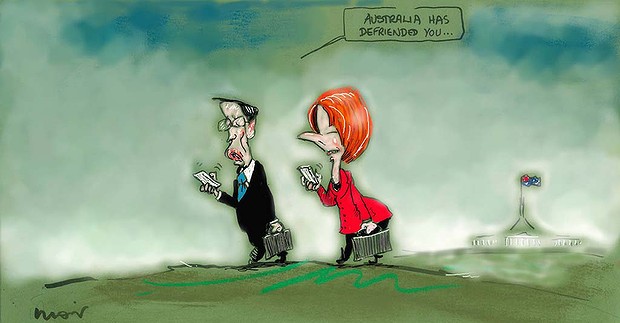
The harmful environmental consequences of economic production based on using energy from coal-fired power stations continues to be downplayed--the 'science is not settled' talking point. This is then is used by News Ltd to obscure the issue of market externality and the failure of the free market to deal with the greenhouse pollution issue. News Ltd's distortions and deceptions on this issue are an example of how the Australian media has failed Australian citizens.
The implication of the negative position is that because certain environmental costs of production are not reflected in the market cost of energy, then the externalities are not priced into the marketplace. Consequently, the associated environmental degradation will also be ‘‘locked- in’’ and, as a consequence, more environmentally benign technologies could be ‘‘locked-out’’.
The manufacturing sector is not talking about the opportunities present to it from the adoption of energy efficiency and renewable energy technologies, or the growth that will come from the need to build markets for new energy technologies. Their whole case is primarily based on energy from coal exhibiting a clear absolute cost advantage. They want to keep that advantage (the 'international competitiveness' talking point) and to hell with the costs resulting from the impact of climate change attributable to the emissions of greenhouse gases.
They have been able to block reform because of the large role for emissions-intensive industries in the political process. The political reality is that the carbon pricing legislation will be passed. Next in line is the closure of the most polluting of the coal-fired power plants (eg., Hazelwood in the La Trobe Valley and the Port Augusta power stations in South Australia) and to provide replacement energy capacity. This is part of the carbon pricing package--Clean Energy Future Package-- and the energy transformation needs to be done in a way that protects communities and workers.
The Coalition continues to be in a wrecking mode on climate policy with Abbott spending his usual week spreading doom and gloom about the carbon tax and working up his smart lines for media grabs. The Coalition's policy cupboard is looks to be very threadbare (its reduce taxes, make big spending cuts, have a big budget surplus and fund all promises).
Posted by Gary Sauer-Thompson at 8:56 AM | Comments (12) | TrackBack
October 8, 2011
Republicans as cowboys
The conservatives in the US are angry this year. They're looking for a fighter amongst the Republican presidential candidates who can take hard swings at Barack Obama.They see the country going down the drain. They're looking for somebody with proven results and proven success, who has "grit and determination", who'll come in with guns blazing. That person, for them, will have the authority to do what he says he's going to do.
They want Clint Eastwood, the cowboy as the lone gunslinger taming the lawless frontier, whilst preaching a small-government, light-regulation libertarian philosophy. The underside in the GOP is incompetence and extremism.

The cowboy fighter ain't going to be Sarah Palin. She appears to be content to remain a celebrity; a media figure whose political voice has dwindled. Her political career was brief, bizarre, and sordid. According to the Beltway pundits the two candidates most likely to win the Republican presidential nomination are the Texas Governor Rick Perry and former Massachusetts Governor Mitt Romney.
The GOP is drawn to arguments that play on male anxieties about strength and potency. Most recent campaigns have featured Republicans asserting that their candidate is manly and strong, while the Democrats’ candidate is effeminate and weak. George W. Bush’s playacting cowboy routine was entirely theatrical, and the intimation of violence in his rhetoric--remember his “bring ’em on” about the Iraqi insurgents---was plain vicarious.
The GOP has been pushed to an extremist anti-tax position by the Tea Party that has elevated ideology above all else. The latter think that turning back the clock to 1925 and freeing America’s Horatio Algers from taxation and red tape is how to ensure economic growth in today’s global economy. They don't understand fiscal policy and don't know their way around the major financial institutions.
Posted by Gary Sauer-Thompson at 3:46 PM | Comments (7) | TrackBack
October 7, 2011
America needs Jobs
Is the Occupy Wall Street movement in the US an attempt to change the political climate in the US?
The political context is the failure of Washington to deliver economic recovery and the realization that the US political system is increasingly being run for the benefit of the financial elites on Wall Street.

There is an absence of proposals--eg., America needs Jobs--- within the movement in spite of a decade in which the American middle class shrank. More jobs are expected to be lost at worst; or not enough jobs created to keep up with normal population growth at best. Maybe the lack of demands is intentional.
Will Occupy Wall Street take a different tack to the Tea Party's recycling the standard right-wing set of demands--lowering taxes on the wealthy, reducing regulations on corporations, and cutting spending on the poor--by demanding repeal of the Bush tax cuts on the rich, stricter financial regulations, more stimulus spending, etc? Will Occupy Wall Street shape the debate over economic policy in the US about the growing inequality?
In the New York Times Paul Krugman outlines how outrageous the story of the US' economic woes is in three acts:
In the first act, bankers took advantage of deregulation to run wild (and pay themselves princely sums), inflating huge bubbles through reckless lending. In the second act, the bubbles burst — but bankers were bailed out by taxpayers, with remarkably few strings attached, even as ordinary workers continued to suffer the consequences of the bankers’ sins. And, in the third act, bankers showed their gratitude by turning on the people who had saved them, throwing their support — and the wealth they still possessed thanks to the bailouts — behind politicians who promised to keep their taxes low and dismantle the mild regulations erected in the aftermath of the crisis.
On the We are the 99 Percent blog we have the personal stories of people who have, seemingly, done everything right but are still struggling with debt, unemployment, and a stagnant future.
Posted by Gary Sauer-Thompson at 1:47 PM | Comments (7) | TrackBack
October 6, 2011
Steve Jobs: RIP
Steve Jobs is dead at 56. That's pancreatic cancer for you--it is fast and aggressive with a low survival rate. Job's death is a world event due to his influence in shaping a digital world (he revolutionized computing, telephony and music) with his innovative and elegantly designed products, whose marriage of hardware and software was elegant, easy to use and playful.

Apple--no longer Apple Computer--- is currently the most successful and influential company on the planet, and Jobs legacy as a transformative capitalist is on par with Edison and Henry Ford, in spite of his many flops.
Although Microsoft won the PC wars I personally switched to Apple's Intel based MacBook just after Microsoft introduced Vista. I've never looked back, going on to invest heavily in Mac computers because they work. Windows Vista was the final straw for me with respect to Microsoft, and the crap shoot of Windows machines designed for a business environment.
Unlike many I, as a creative professional, am still okay with Apple's walled garden, even if I dislike the secrecy and control freakery that goes the innovation as do those who prefer the open-source operating system, like Google’s Android. The dark side of Apple is its ability to play the game of cutthroat capitalism: it keeps labor costs as low as possible while maintaining a stranglehold over exactly how its hundreds of millions of customers interact with both the innards of its gadgets and the wonders of the Internet, and it wields a ruthless intellectual property litigation strategy to ward off competitive threats to market share.
The products (iPods, iMac, MacBook Air, iPad) are often dismissed as extravagant, unnecessary toys (or mediocre products at extravagent prices), and Apple is dismissed as relying on brand image and loyalty. The MacBook Pros and the Mac Pro tower computers are professional workhorses. The iPhone, which is incorporating artificial intelligence in a mobile device with the iPhone 4s, has changed the way we understand and use phones as communications devices.
Apple is at the crossroads of technology and humanities or liberal arts, since Job's emphasis started from the users experience of technology. That meant that technology should above all be user-friendly---the specs of a device aren't as important as what it can actually do, and how easy it is to use. The opposite view is that the role of people is to learn how to use technology---ie., computers are hard, and therefore people must learn about them. Apple's approach-- make technology easier to use--- is the best one as the technology meets people's needs, lets them do the things they want, allows then to get value from them, and to enjoy using them.
Posted by Gary Sauer-Thompson at 6:04 PM | Comments (9) | TrackBack
October 5, 2011
tax forum
What will come of the Canberra tax reform summit? Will it be similar to what happened to the Henry review of the Australian tax system? Will the Gillard Government ensure that nothing much will result from the talk-fest so that it doesn't become a political issue.
The Gillard Government has enough on its hands with respect to tax reform, namely the mining tax, and the pricing of carbon that many continue to call a tax. One of the ground rules Wayne Swan, the federal Treasurer, laid down was that all proposals for tax reform had to be ''revenue neutral'' - if you cut one tax you have to increase another by the same amount. Talking down expectations is the way Labor governs these days.

I don't expect much to come out of the tax forum because the Australian political system has been struggling to secure reform over the past decade with little success. What would be of benefit is a way to institutionalize the process of tax reform so that it is taken out of the hands of vested interests preaching their standard ideas to further their own interests.
Economic inequalities in Australia are growing and without significant tax reform on income tax we can expect growing economic and social imbalance--ie., increasing private affluence and public squalor.
Posted by Gary Sauer-Thompson at 10:38 AM | Comments (4) | TrackBack
October 3, 2011
it drags on
The latest proposal for resolving the Euro-zone debt crisis is a sketchy plan that entails Greece restructuring its debt with writedowns around 50% and recapitalisation of the affected banks. The European Financial Stability Funds (“EFSF”) would increase its size to a proposed Euro 2-3 billion from its current Euro 440 billion. This would enable the fund to inject capital into banks and also support Spain and Italy’s financing needs to reduce further contagion risks. Illusion is giving way to reality.

Greece acknowledged over the weekend that it won’t meet its debt targets. it is becoming increasingly obvious to the financial markets that the politicians in Europe is not on a path to resolving its burgeoning sovereign/bank crisis. It is insisting on imposing austerity on debt burdened countries, which will only shrink their GDPs, making their debt hangovers even worse.
Europe is in the midst of its variant of the great debt crisis that hit the United States in 2008. Jeffry Frieden reminds us in the US:
the boom became a bubble and the bubble burst; when it did, it brought down the nation’s major financial institutions – and very nearly the rest of the world economy. The United States is now left to pick up the pieces in the aftermath of its own debt crisis....Europe’s debtors went through much the same kind of borrowing cycle. ...as in the United States, the boom was not sustainable. When the global financial crisis began in October 2008, the European debtors were largely frozen out of financial markets. As their economies spiralled downward, they faced grave difficulties in servicing their debts. The problems of Europe’s debtors were not just worrisome for the debtors themselves. Most of their debts were owed to Northern European banks and investors, and the crisis threatened the very solvency of major European financial systems
The rationale for Europe’s ongoing debt bailout is that a collapse of Greek or Portuguese finances could harm the rest of the euro-zone financial systems. If Bank of America was too big to fail, then so was Greece.
Friden adds that in Europe as in America, the real question is how the costs of this devastating debt crisis will be distributed. Who will pay – creditors or debtors? Taxpayers or government employees? Germans or Greeks? More realistically, what combination of sacrifices will be politically tenable, both across countries and within countries.
Posted by Gary Sauer-Thompson at 10:42 PM | TrackBack
October 2, 2011
Palestinian statehood
The decades of obstruction by Israel and the United States to prevent a Palestinian state continue with the US rejecting the Palestinian application, for statehood handed to UN Secretary-General Ban Ki-moon last week.
The United States and Israel are devising a face-saving formula to kill the application in the Security Council ln the context of the Arab Spring and its wave of popular demands for human and political rights.The present bid for statehood will be defeated by a US veto, highlighting the power of the Israel lobby in the US.

What this shows is not just that the US and Israel work to bloc kthe peace process but that the US foreign policy in the Middle East is beholden to Israel. Israeli continues with the demolitions of Palestinian homes and its settlements,. The US, in siding with one of the most right-wing, pro-settler governments in Israeli history, has given up talking about, or acknowledging Israeli occupation of Palestinian territory.
So a two state solution is dead. We have the ongoing Israeli colonization of the West Bank and East Jerusalem under the benevolent gaze of the Obama administration. The so-called peace process is designed to give political cover to Israeli colonization and to maintain America’s diplomatic monopoly--the United States government remains the custodian and broker of any peace negotiation. The 1993 Oslo Accords are no longer be the framework for future negotiation.
What is left on the table is the one state solution? It does appear that the Palestinian leadership has decided to finally take matters out of the hands of American diplomats who for decades have systematically advanced Israel’s interests at the expense of the Palestinians. Can they succeed in reunifying the divided Palestinian national movement?
Posted by Gary Sauer-Thompson at 7:51 PM | Comments (1) | TrackBack
October 1, 2011
GST: no longer a growth tax
George Megalogenis is one of the better columnists in the News Ltd stable. He discusses policy issues instead of politics, and he does research instead of the polemics against, and yelling slogans about, the Gillard Government. It makes a welcome change from the superficial nonsense that is routinely peddled by the mainstream media.
His Swan needs to read the bottom line; the GST is burning a hole in his budget column in The Australian is a good example as it highlights one of the issues that needs to be addressed in tax reform. The Australian tax system does require an overhaul to facilitate a more productive economy.
In his column Megalogenis raises an important issue:
The GST was supposed to abolish inefficient indirect taxes and take the weight off income taxes. It was also meant to leave the states better off, because the GST replaced the annual begging-bowl festival of the premiers' conference. The GST achieved all three goals for a while, but the past few years have seen John Howard's proudest reform lose its value to the nation.
The temptation on the Coalition side is to blame every red mark on fiscal policy since 2007 on Labor, but the GST is unarguably the Coalition's baby. At the peak of its revenue-raising powers in 2002-03, GST collections were worth 3.9 per cent of gross domestic product. The final Peter Costello budget in 2007-08 left them at 3.7 per cent. Next financial year, they will be 3.4 per cent. The gap of 0.5 per cent of GDP may well be the difference between federal surplus and deficit in 2012-13.
Simply and directly stated: the GST is no longer a growth tax. That has implications for the states since they depend on the commonwealth for nearly a half of their revenue.
It cannot be laid at the door of the Gillard Government because the GST was the Coalition's baby and three of the nation's four biggest states - NSW, Victoria and Western Australia - are already in conservative hands. Every dollar Canberra doesn't raise from the GST is one more dollar the states have to find elsewhere in their own budgets.
Megalogenis also give us an explanation for why the GST is no longer a growth tax. The advice in this year's budget is that the GST is losing ground because the items not in the base - food, rent, health and education - have experienced faster price rises than the goods and services that are taxed.
Megalogenis also highlights the significance of the GST 's decline for the federal government and states:
Swan and the conservative states have a mutual reform interest in the GST. Swan needs to restore federal revenue as a share of GDP, while the states know they have to secure their budgets beyond the phony accounting of property and gambling booms. Voters in NSW and Victoria, in particular, dismissed their Labor governments because they had not spent enough on public infrastructure. If Barry O'Farrell and Ted Baillieu want to avoid history's stain of being do-nothing premiers, they need more revenue from Canberra so they can open their wallets on behalf of their states.
So Australia has a policy problem that rises above the current right left polemics hostilities. Should there be a 12.5 per cent GST? Or a GST with an expanded base? What should be done with the inefficient indirect taxes (eg., stamp duties) of the states? Should the GST continue to be used to take the weight off income tax?
These are issues that should be included for discussion amongst others in the two-day tax forum this month. A tax forum discussion paper has been released.
Posted by Gary Sauer-Thompson at 9:50 AM | Comments (9) | TrackBack